Tuesday, January 26, 2016

Pilgrimage to the Heart - Part 2


For me, the Heart of the Yatra (Pilgrimage) was the trip to Kedarnath.  This was our first look at the high Himalayas. We traveled to the Guptakashi area during the day, and the high mountains are hidden behind the lower peaks. We arrived during the night and were not able to see what was outside the bus windows. When we woke up the next morning, this was the amazing and breath-taking sight that presented itself to our eyes.

Kedar is one of the names of Lord Shiva, Lord of Yoga. Kedarnath represents Lord Shiva in His most resplendent and most serene form. Kedarnath is located at 30 degrees 44'05.78" N, 79 degrees 04'00.76" E, elevation 11634', in case you want to locate it on Google Earth.

The mountain itself has a garland of two glaciers around it like a necklace. They form the Mandakini River,  which is also one of the ancient names of the Milky Way, the Celestial River of Heaven.  The Kedarnath temple sits in the lap of the mountain. The two rivers run on both sides of the town, which is just a few pilgrim hostels. In Pilgrimage to the Heart - Part 1, I shared how Kedarnath was nearly destroyed by a catastrophic flood in 2013. The temple was built by people who really knew what they were doing.  Much debris remains from the flood devastation, and there were bulldozers there continually moving rubbles. The town itself is very small, only about 250 residents. Pilgrimage huts and tents are set up to accommodate pilgrims.

The town is empty during the winter months from Karittik Purnima, the full moon of November. Then the temple is closed, and the movable deity images are taken down the mountain to their winter home. The temple doors are locked and not re-opened until April when intrepid devotees shovel their way through several feet of snow to the temple. Sharmila told me that during the time when the temple is closed, the devas (the celestial deities), come to the temple for worship and keep the temple lamps lit.  When the doors are first opened in the Spring, thousands of people are there waiting to see the lamps still lit.

Kedarnath is very ancient, so old that no one knows how old it is. It was renovated by Shankaracharya, the great teacher of Vedanta in the 8th Century.  From this spot, he departed into the mountains and was never seen again.

Gail Minotti and I were very eager to visit here. There is no road to Kedarnath, only a 14 km path from Gaurikund, the nearest town.  Ponies and helicopters are available, but Gail and I wanted to walk it.  It so happened that the day before the Kedarnath trip, we went to the Tungnath Temple. I didn't realize this was a 6 km (one-way) uphill hike to a higher altitude than Kedarnath. It was certainly worth it, but it did me in. I was afraid I would not be able to handle the Kedarnath hike the day after Tungnath. Gail decided to go by pony. I haven't been on a horse since I was a teenager and I had serious doubts about this, but I decided to go with her.

I had been watching the weather at Kedarnath on the internet before we left Louisville, so I thought we were pretty well-prepared.  The day before I had gone slightly higher than Kedarnath to the Tungnath Temple wearing a light jacket and shawl and was very comfortable.  Still, I put on long underwear, wool socks, a jacket, and packed two shawls, an extra pair of shoes and socks. Gail and I both had rain ponchos and altitude sickness pills.

It started out badly. We arrived at Gaurikund and no one spoke enough English for us to be understood. After 30-40 minutes of fumbling around, we realized we need to get a permit to go up the mountain.  Pilgrims to Kedarnath must have a retinal scan (so they can identify your body later), a medical exam to determine if you are fit for the climb, and register for a permit.  A cluster of enthusiastic pony drivers helped us so that we would hire them.  Which we did.  So, we got all that done, got our permits and followed our drivers to the ponies, which were actually mules (not a bad thing!). Gail's pony tried to buck her off and kick her, but Gail seemed unfazed by that, which was very impressive.

We got started. It was horribly painful for me. After 30 minutes I was sure I would die, do permanent damage to myself and never be able to hold mula bandha again. I tried getting off and walking for awhile, but the air was so thin, and the pace of the ponies was so fast, I got tired really fast and had to get back on.

We passed a place where there was twisted steel wreckage. We later learned this was the location of Ramwara, a village that was completely washed away in the 2013 flood not leaving even one brick of the town. There were no survivors.  Even though we didn't know that as we passed it, the feel of the place was unusual.

We climbed continually upward. It was a very difficult trip, even on pony. The path was washed out and rough in many places. You had to really hold on to keep from being jostled off.  I couldn't take any photos for fear of dropping my cell phone off a cliff. The drop-offs at the path's edge were heart-stopping. In the beginning, there were many people working on the path to repair it and sweep it. Because of the ponies, there was a lot of manure and sweepers were continually sweeping to clean the path. It was amazing how many people were there to keep the path clear. Even the outhouses were clean and very well-kept.  Along the way we passed officials who asked us to show our permits and checked off our names on clipboards. It seemed very organized.

At some point, it began to rain lightly.  We stopped at a tea stall and had tea and put on our rain ponchos. The ponies began to roll around on the ground and mine still had my purse on it with my cell phone in it!  I managed to retrieve it, and my phone was okay. Then we continued on.  It began to rain harder.  Then it began to hail.  It hailed and hailed.  Soon the path was covered.

We passed a field hospital and many pilgrims had stopped there.  It was like pictures I had seen of refugee camps.  We continued on for perhaps another kilometer, and then it was apparent that we couldn't go on.  The precipitation was now coming down so heavily it was hard to see. It was a combination of hail, snow and sleet and it had covered the path. Footing was treacherous.  The ponies were slipping and sliding.  Our pony drivers led our ponies into an open-air shelter and indicated we should get off and go on by ourselves.  They pointed off into the distance into which we could see absolutely nothing and motioned that we should keep going. "One kilometer!" they yelled above the sound of the sleet and wind.  I looked around at the pony drivers in their light jackets and sweaters, some shivering uncontrollably.  I wondered how they would get back. Gail gave her hat to one of them.

Lightning and thunder started, very loudly and continuously.  We were in an open river gorge between huge peaks. There was no shelter at all.  There was nothing we could do but set off as quickly as possible into the Himalayan blizzard.  Already the ice and snow was about four inches deep and very slippery, and it was coming down so relentlessly that it was hard to see ahead.  The thunder rolled and echoed with a weird metallic clang that resonated through the mountains. It also gave our situation an awesome, rather heroic quality, as if we had a Wagnerian soundtrack for our ordeal.  My feet were soaked and going numb. I said to myself, "Put one foot in front of the other."  I walked on. Our friends Michelle and Gary, who had started ahead of us, had disappeared into the white-out.  I was getting very cold. I kept looking back to make sure Gail was there and just kept walking.

I don't know how long we walked.  I repeated my mantra and tried to keep my hands warm under the poncho, but the wind was whipping everything around.  I looked up, and ahead in the distance I could see some structures and right above them, I saw the roof of the Kedarnath Temple!  At that moment I felt I had wings and remembered Rumi's poem:

Who gets up early
to discover the moment light begins?
Who finds us here circling, bewildered, like atoms?
Who comes to a spring thirsty
and sees the moon reflected in it?
Who, like Jacob blind with grief and age,
smells the shirt of his lost son
and can see again?
Who lets a bucket down and brings up
a flowing prophet?
Or like Moses goes for fire
and finds what burns inside the sunrise?
Jesus slips into a house to escape enemies,
and opens a door to the other world.
Soloman cuts open a fish, and there’s a gold ring.
Omar storms in to kill the prophet
and leaves with blessings.
Chase a deer and end up everywhere!
An oyster opens his mouth to swallow one drop.
Now there’s a pearl.
A vagrant wanders empty ruins.
Suddenly he’s wealthy.
But don’t be satisfied with stories, how things
have gone with others. Unfold
your own myth, without complicated explanation,
so everyone will understand the passage,
We have opened you.
Start walking toward Shams. Your legs will get heavy and tired.
Then comes a moment of feeling the wings you’ve grown,
lifting.
--Coleman Barks, The Essential Rumi

I went back and told Gail I could see the temple. Then a man in a uniform with a walkie-talkie appeared out of the storm and greeted me smiling warmly. He motioned me toward a building. Inside, I saw our yatra companions. There was no heat in the building, but there was hot food and it was certainly more dry than being outside.

As it turned out, no building in the town had heat and many buildings still did not have power. Gail and I were assigned to a room that was dark, damp, cold and had no power. Already I was starting to shiver uncontrollably and I had no way to dry my feet. I tried to find something else warm to wear at the few stalls selling items. Joseph, one of the helpful young men on our yatra, went out and found me some wool socks.  I tried warming myself at the fire of some sadhus, but the fire was so small and so smoky it was not very helpful.  I told Yoginder, one of our tour leaders, that I thought I was getting too cold, and he said he would send a heater to our room.  However, Michelle and Oana didn't wait - they insisted I come to their room because they had power and hot water.  So I did. They and Jamie stuffed me into a sleeping bag and Michelle gave me her hot water bottle. It still took three hours for me to stop shivering and I slept a little bit that night.

Next morning, as soon as it was light out, I got up and found that my shoes and socks had dried out. I put them on and went to see about Gail. I found her coming down the path carrying my backpack. I was relieved that she was okay.  We went back up to the temple, which was not open yet.  Gail had gone to the evening arati (worship), but I had not been to the temple yet.  

At every Shiva temple, there is a statue of his bull Nandi out front, facing the image of Lord Shiva (the lingam).  In the ancient stories of Lord Shiva from the Puranas, Lord Shiva gave Nandi the boon that whatever a devotee whispered in Nandi's ear would be heard directly by Lord Shiva.  I had whispered into Nandi's ear at every Shiva temple we visited on our yatra, "Laura from Kentucky here, and tell Lord Shiva I want to see Him at Kedarnath."   I fell onto Nandi's neck weeping with gratitude... until another pilgrim brusquely shoved me aside so his friend could take his picture. But that's okay.

Thanks to the storm that Gail and I encountered, there were very few people there at the temple and we could spend a lot of time in the temple itself experiencing the divine Presence.  I tried to soak it in as much as possible, but it's still a fuzzy memory. I remember the priest repeatedly banging my head into the lingam saying, "Think of your parents! Think of your mother! Think of your father!"  I stood by the ancient wall, trying to fix the details of the shrine in my memory and watched others as they worshiped.   

To be continued...

Pilgrimage to the Heart - Part 1

A "yatra" is a spiritual pilgrimage.  In many spiritual traditions, visiting sacred places or holy beings is an important spiritual practice.  I've written about my 1986 trip to India in an earlier blog article.  In 1986 I visited some important pilgrimage places, like the town of Haridwar in North India on the Ganges River and the Grishneshwar temple in Maharashtra.  

I started planning my 2015 yatra on November 27, 2014. I was already in bed when I checked my email on my phone one last time and saw I had received an email from Namarupa Magazine describing a yatra to North India in October, 2015. Two things caught my attention: the first was that the yatra included a week-long Ashtanga retreat with Sharath in the famous pilgrimage town of Uttarkashi and the second was that the yatra included a visit to the Kedarnath temple.  I jumped out of bed to read the full email on my computer. I recalled that when Sharath visited Louisville in 2003, a student asked him if he had been to the Himalayas, and Sharath answered, "No, if I go there, I'm not coming back."  I understood why Sharath said that.  The Himalayan region is the birthplace of yoga. Many great yogis, yoginis, rishis and siddhas have lived and practiced in the Himalayas and experienced revelations there which form the teachings of the yoga tradition.  The thought of visiting these sacred regions was as alluring to me as it was to Sharath.  I had read about many of the temples and sacred places and I saw that the Namarupa yatra included several temples that were on my bucket list of places I wanted to visit. The temple at the top of the list was Kedarnath!  I immediately paid the deposit to reserve a place.

Kedarnath is one of the twelve jyotirlinga temples in India. Grishneshwar, which I had visited in 1986, is one of them and it had a big impact on my life.  I feel that my brief visit to this temple changed the course of my life.  The lingam is the main form of the deity in most Shiva temples. It represents the formless, transcendent aspect of the Divine as Supreme Consciousness. Sometimes mistaken for a phallic image, it depicts the Divine form of Shiva as an infinite column of light.  These temples to Shiva in the form of divine light are ancient, sacred places of worship and have attracted many millions of worshipers over the millenia. Kedarnath is the most remote jyotirlinga temple. 14 km from the nearest road, it can be reached on foot or by pony. Helicopter service is also now available from nearby towns.  Kedarnath sits in the lap of the Kedar peak, in a remote location. 11,755 feet high, closed by snowfall from November through the end of April, it is still visited by thousands of pilgrims every year. 557,923 pilgrims visited Kerdarnath in 2007. 

That so many people go there is all the more amazing considering that Kedarnath suffered a terrible disaster in 2013, the worst to hit India since the Indian Ocean tsunami of 2004.  On June 16, 2013, an unusual weather pattern combined with spring snow melt and monsoon rain. A heavy rain fell for twenty-four hours on the mountains above the town. The Mandakini River runs from Kedarnath peak and is a tributary of  the Ganga. Just after nightfall on June 16, the river flooded the town.  People fled to the temple, which is on higher ground, to take refuge.  Unfortunately not all could fit inside the temple or on the raised platform on which the temple sits.  During the night several buildings and an unknown number of people were washed away.  Survivors described their terror, listening the river raging on both sides of the town.  A few hours later just before dawn, survivors described hearing an even louder sound, the loudest sound they had ever heard.  The embankment of a lake on the mountain above the town collapsed and a wall of water hit the temple and remaining buildings of the town, causing further devastation and loss of life.  The official death toll was 5700, but the exact numbers are unknown due to large numbers of pilgrims being present. Over 100,000 pilgrims were stranded in the area. Footpaths, roads and modern steel and concrete bridges had been washed away.  It took several days for the Indian army to helicopter thousands of people to safety. Amazingly, the temple survived the flooding with relatively little damage.

At first the state government of Uttarakhand announced that the pilgrimage route to Kedarnath would not re-open for four years due to the damage to the route.  There were even proposals that the temple should be moved because the ground was so contaminated with the dead.  But the temple re-opened the very next year, 2014, but the area is not back to normal.  When our Ashtanga Sadhana Retreat took place with 150 participants, the local people told us that this was the largest group to visit the Uttarkashi region since the flood.  Those of us who took the ponies or walked the pilgrimage route in 2015 saw lots of construction and repair going on, but the destruction that remains is a very sobering sight.

The stories and history of the temple are unique. It is said to have been founded by the Pandava brothers, the heroes of the Mahabharata War (8th-9th centuries BCE). The Pandava bothers wanted to atone for the crimes they committed during the war and sought out Lord Shiva to obtain His forgiveness.  Unwilling to give them forgiveness so easily, the Lord eluded them in the mountains.  As they chased him, He took the form of a bull.  Diving into the ground at Kedarnath, he left a lingam there in the form of the bull's hump, his heart and arms at Tungnath, his hair at Kalpeshwar, his face at Rudranath, and his navel at Madhyamaheshwar. Pleased, the Pandavas built temples at these places.  Adi Shankaracharya, the great teacher of Vedanta venerated by Shri K. Pattabjhi Jois, renovated Kedarnath temple in the 8th century CE and disappeared from this spot into the high mountains.

Here is a description by Swami Akhandananda, on his pilgrimage there in the late 1880's. 


Kedarnath, October 21, 2015, early morning
When I first saw the entirely snow clad, huge and bright peak on which the temple of Kedarnath is situated, I was stupefied. ...The temple of Kedarnath was on the lap of a huge peak and the entire peak was now revealing itself before me. It was as bright as the glowing morning sun. Thousands of soft rays were emerging from the peak and they were all enveloping and overwhelming me. I thought to myself that I had come to this place of eternal light leaving the eternal darkness permanently behind. I could not look at the snow-white peak for long. My eyes became indrawn and the huge peak of the mountain appeared before me as an eternal uncreated symbol of Siva. This was no imagination. It was a divine experience. Nowhere else in the entire Himalayas you can see such a resplendent form of Siva.... To have such a vision is a great event in one's life. (Swami Akhandanada, In the Lap of the Himalayas, Sri Ramakrishna Math: 1980 103-104).
Before we got to Kedarnath, we stopped at Varanasi, Vrindavan, Haridwar, Rishikesh and Uttarkashi. These are holy cities with important Shiva temples. In Varanasi, we visited the Kashi Vishwanath Temple, one of the twelve jyotilinga temples.  You can read more about this temple on Wikipedia. We had to wait for quite some time to get into this temple. Over 3,000 people visit this temple everyday. On special holidays like Mahashivaratri, over 1,000,000 people visit in one day.  I felt happy about my visit here because, as I was waiting in line, someone pressed a cup of milk and flowers into my hand, and several hours later I was able to actually see the lingam and pour the milk on it before I was shoved out the door.

Even though we had to wait in line a long time, it was very interesting to see and interact with other devotees and the shopkeepers that line the narrow alleys. My thoughts are always, "Here I am standing in line waiting to see God, and all I can think is, "I hope I don't have to pee." It's the human condition. I know God understands.
Varanasi - the temple is unseen, beyond the ghat.
At Vrindavan, which is a town sacred to Vishnu in the form of Lord Krishna, we visited the Gopeshwara Temple. According to legend, Lord Kishna lived here and his most exalted devotees were gopis, the humble milkmaids who would leave their homes and families at night to dance with Krishna in the moonlight beside the Yamuna River.  Lord Shiva wanted to experience this for Himself, but only women were allowed to be present. Parvati, Shiva's consort, was accepted, but Lord Shiva was turned away.  He bathed in the river and assumed female form and dressed as a gopi. When he began to dance, however, he gave Himself away, for Shiva is Nataraj, the King of the Dancers. Krishna recognized Shiva and embraced Him. Shiva remained in Vrindavan as Gopeshwara "The Gopi Lord" and is the protector of this sacred realm. When entering Vrindavan, it is customary to visit Gopeshwara first to destroy your egotism and purify yourself.
Vrindavan, where the gopis danced.
Next we visited Haridwar, one of the sacred cities of India and a location of the Kumbh Mela, a huge religious festival that marks the places where the gods and demons fought and spilled the nectar of immortality. I had visited Haridwar in 1986, and it didn't seem that different to me in 2015. We had a great time here at the Ganga Arati and bathing in the river. I have posted videos of the arati celebration on my Facebook page.
A crowd begins to gather for the evening arati celebrations.
On our way up into the mountains we stopped at Rishikesh briefly to visit the samadhi shrine of Swami Sivananda. 
Samadhi Shrine of Swami Sivananda
This is where the remains of Swami Sivananda are entombed. Swami Sivananda was the founder of Sivananda Yoga, the first form of yoga that I learned.  Back in those days, 1967-1990, there were no classes that I could find and I could only practice it from a book which was written by one of his disciples, Swami Vishnudevananda.  One of our tour leaders, Robert Moses, had been a student of Swami Vishnudevananda. When we were still in new Delhi at the beginning of our trip, I had the good fortune of attending a class taught by Robert at the New Delhi Sivananda Center.  I enjoyed the class very much and was relieved to learn that I had practiced it correctly all those years.  I might still be practicing Sivananda Yoga except for moving to Louisville and meeting Maja Trigg, founder of Yoga East. Maja introduced me to Iyengar Yoga and when she retired I met David Swenson and began practicing Ashtanga Yoga.

I owe a debt to Swami Sivananda for giving me a wonderful start on the path of yoga. I certainly feel blessed to have found his teachings. I never thought I'd be able to go to his samadhi shrine, but there I was. 

Deodar forest on the approach to Uttarkashi.
At Rishikesh, the roads started to get pretty scary. A lot of the time they were barely one-lane, gravel, no shoulder, no safety barriers, sometimes partly washed away, and with drop-offs of a thousand feet or more. Plus, we were in tour buses. My heart was in my throat most of the time as we got higher and higher and the roads were more and more hair-raising. Finally we arrived at the town of Uttarkashi, the location of Swami Tapovanananda Ashram, where the Ashtanga Yoga Sadhana Rtreat with Sharath and Saraswathi would take place.  Uttarkashi also has a temple to Shiva called Kashi Vishwanath, like the one in Varanasi, and it was too remote to have been attacked by the Muslim emperors. While we were there, they were renovating part of the temple. However, my favorite place here was by the river, where it is called Bhagirathi. It doesn't become the Ganga until it joins the Alakhananda River at Devprayag.  


River bank at Uttarkashi.

A devotee serving lunch.
Gail Minotti, Karen Cairns and I shared a room. Karen and I joked that our family and friends back home probably visualized us sunning ourselves on the sandy banks of the Ganga, being served frosty glasses of bhang with trident stirrers by handsome young sadhus wearing loincloths.  No! The ashram was quite spartan. Frequently the power was out, and there was only hot water for a couple of hours in the early morning. The beds had mattresses like plywood boards, the hardest beds I've ever slept on. The food was very good ashram food, but simple - dal, rice, a vegetable, chapatis and tea.  There was no internet connection.  

It was difficult to get to the river because of the rocks and debris left from the flood.  One had to clamber over rocks.  I don't have many photos of the river because it was treacherous to get there. I didn't want to break or lose my cell phone. Once you got to the river it was cool and clear. One time I slipped and fell into an open sewer, but luckily I was able to wash myself off in the river.  
Saraswathi and Sharath arrived and they taught a led Ashtanga Primary Series class every morning in the meditation hall. Here is a photo of Saraswathi wearing the Kentucky Oaks T-shirt we gave her. (She is so cool!)  Behind us is a photograph of Swami Chinmayananda, a disciple of Swami Tapovanananda, and the guru of Swami Dayananda, with whom many of us studied at Arsha Vidya Gurukulum in Pennsylvania. 
View from kutir of Swami Tapovanananda
I purchased some books at their bookstore, and Gail and Karen and I spent time meditating in the kutir (hut) of Swami Tapovanananda.
.
Conference with Sharath by the river.
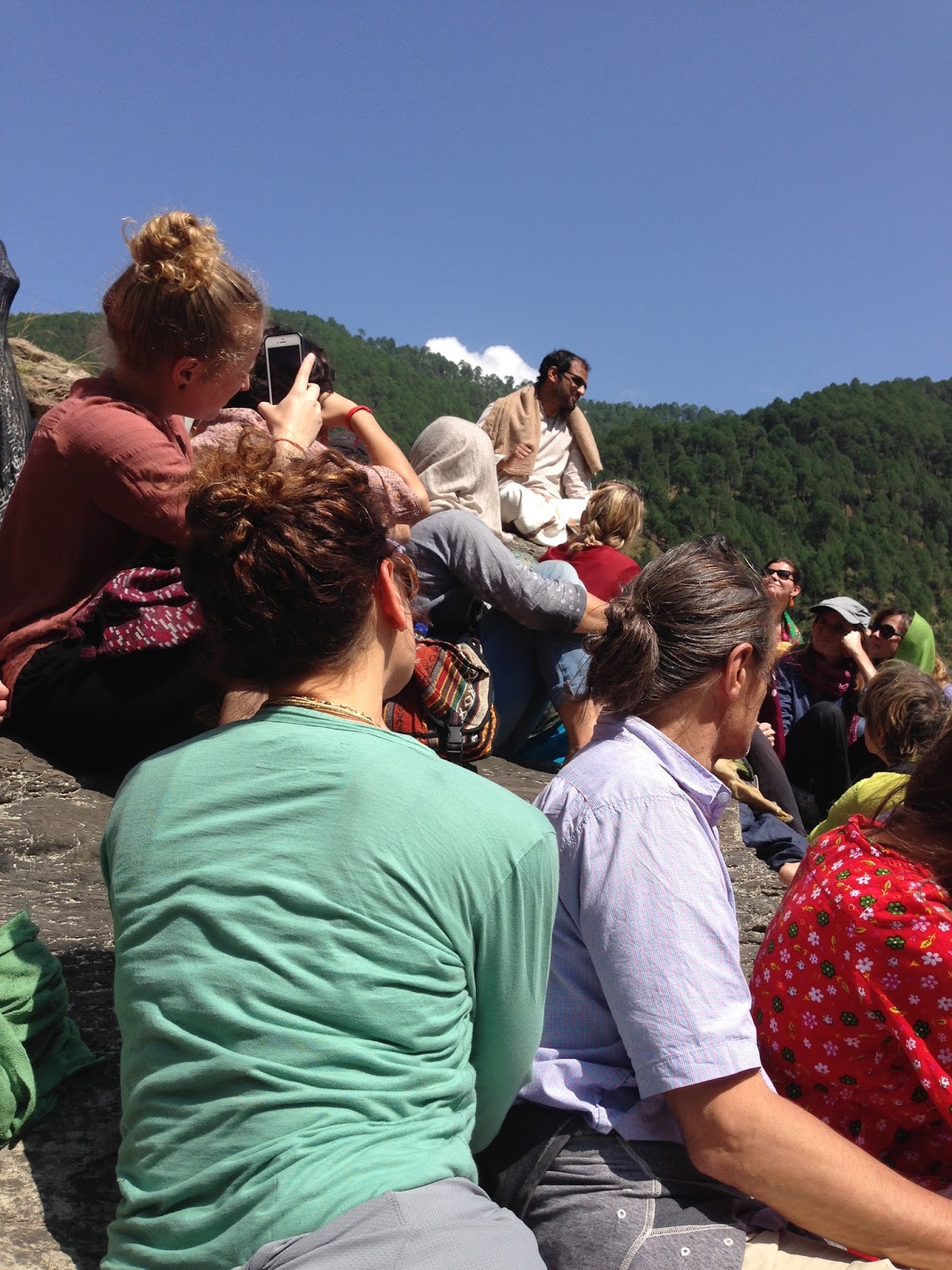
Sharath gave conference on the river and spoke to us of the importance of yoga practice, made all the more clear because across the river from us a funeral was in progress. As one of my teachers once said, we practice yoga not so much to have a good life, but to have a good death.  The lesson took on further meaning a few moments later when a member of our party slipped and fell on the rocks and broke her leg. Luckily, one of our yatris was an orthopedic surgeon and knew what to do.  She was flown back to New Delhi on a helicopter to the hospital, returned to the US and has recovered. She handled it all very gracefully - like a true yogini. 


Tungnath Temple - Guptakashi

To be continued....

Temple Tour 2014

Halebid - 2014
In the Summer of 2014 while I was studying Ashtanga in Mysore, I was invited to take a temple tour by Joe Autry. Joe is one of our Ashtanga students, a brilliant sculptor, a beloved yoga teacher, and one of our indispensable volunteer teachers. At first I declined because I've done the temple tour three times already.

The "temple tour" is a trip to Sravanabelagola, Halebid and Belur, three towns near Mysore which are the sites of important temples. The whole trip takes all day if you start very early in the morning.

The first stop is the town of Sravanabelagola where there is an ancient Jain pilgrimage site atop a hill. The site has a temple with a beautiful, ancient (c. 990 A.D.) monolithic statue of a Jain saint, Gomateshvara. It's necessary to go there first to arrive before the sun warms the stone steps up the hill.  The whole hill of mostly bare rock is a holy site and to get to the shrine on top, you must walk up barefoot. The 600 steps get very hot in the afternoon, and that's why you need to start in the morning. It takes about an hour to go up, an hour to come down, and you want to spend time in between. This is the place, incidentally, where Kim Esteran and I saw a wild cobra. As we were walking around the temple, on the back side is a bas relief plaque of a snake, and right below that carving was its live counterpart. I walked up to it to see what it was, and it was a King Cobra about four feet long.  Although its hood was open, it did not seem alarmed. It went into a drain hole and disappeared. My photograph of it is at the Kentucky Street studio on the wall in the small studio.
Gomateshvara

The Jain temple is austere, and there are just a few small sculptures other than the monolithic statue of Gomateshvara. (See above.)  This is the oldest monolithic sculpture in India, and the story behind it is that Gomateshvara, upon becoming enlightened, stood still for such a long time that vines grew around his legs. More information about this fascinating site can be found here on Wikipedia.

I first took the temple tour in 1999 during my first trip to Mysore. I went again in 2002 and 2003.
By contrast to the austerity of Sravanabelagola, both Halebid and Belur temples are riots of sculptures.  The first time I went to the temples I took quite a few photographs. The second time I took a few photos.  By the the third trip I was so jaded I mostly took photos of the people who went with me.  My brother is a sculptor and I have a degree in Fine Art, so I love and appreciate these temples, but I was not at all eager to go back to them a fourth time.  By the time one arrives at Belur late in the day, fatigue has set in and it becomes difficult to focus on the sculptures.
Laura, Karen and Dana at Halebid, 2003.
Dana (formerly Lindley) Christensen and Karen Cairns and I went together in 2003.  Our hotel arranged a car and driver for us.  The car broke down several times during the trip. Flat tire, no spare, no jack. Then the part of the engine that was in the trunk failed (I think this car was made in someone's garage from spare lawn mower parts).  By the time we arrived at Belur, the car would not go faster than 20 mph, and both the headlights and windshield wipers had stopped working.

We were all, including our driver, extremely tired by that time. During that trip I reflected on an NPR broadcast I had heard on Memorial Day the year before. I've tried to research this broadcast but have been unable to find it, but I think it was by Harold G. Moore, author of We Were Soldiers Once..., speaking about the horrors of combat and the true meaning of the term, "fey".  Fey meant "fairy-like", but originates from an older time when the concept of "fairyland" was dark and terrifying.  To become "fey" meant one has become so exhausted one loses the will to live. That was the last thing you wanted to see on the face of the person trapped in the fox hole with you.  At one point during our trip I had just seen a marker by the road that indicated we were still over 100 km from Mysore. I looked at the faces of Karen and Dana and saw that fey look, and I knew I had it, too. I thought we might never make it back to Mysore, but somehow or another we did, although very late.

With all of this in mind, at the last possible moment I decided to go with Joe. He assured me that he had a good car and reliable driver. It turned out to be a wonderful trip, and I saw the temples in a way I had never seen them before. I took almost no photos and spent very little time looking at the sculptures. Mostly I watched people. The temples were very crowded on this trip because it was a Indian holiday.  There were many families there. Children wanted to have their photo taken with me. Normally that would have irritated me, but on this particular day it didn't bother me. I was having fun posing with the children. They were so polite and delightful.  Seeing the fun we were having, mom and dad and then grandma and grandpa would jump in the picture, too. It was very sweet.

By the time we got to Belur I was still feeling energetic. It was later in the afternoon, and the crowds had thinned out.  I was able to look around the temple more and focus on the sculptures.  That's when I realized for the first time that Belur and Halebid are very different from one another.  Up until then, they had always been a mish-mash in my mind - just a blurry mass of sculptures.  The Belur temple was once described to me  by one of the guides as the "fashion" temple because the sculptures depict women who were temple dancers, and the temple carvings show hairstyles, ways of wrapping a sari and hair ornaments.  It's like a pictorial catalogue of fashion at that time. The Belur temple was financed by the Hoysala king, and the sculptures are frontal, formal, and elegant.  It's the "Vogue" of temples. Vishnu in the form of Keshava, the One with Beautiful Hair, is the deity enshrined at Belur. This temple is still active, used for worship.In researching the history of the two temples, I find they were built at the same time, in apparent competition with each other.  The Belur temple financed by the king, and the Halebid temple financed by wealthy devotees of Lord Shiva.

The bottom of the first photograph showing Joe with his camera.
The photograph at the beginning of this article is from Halebid, the Shiva temple. I was actually photographing Joe photographing the sculptures. The Halebid sculptures appear to have been created by hallucinating artists. The sculptured figures writhe as if trying to break free from the stone matrix. Although the temples have similar floor plans, the temple at Halebid has cul-de-sac dead ends in which one finds oneself surrounded by figures that are intensely grotesque.  Skeletal goddesses perform austerities to win the heart of Shiva. Goddess Kali with pointed tongue and fangs voraciously bites off the heads of her victims.  Shiva dances ecstatically with snakes, skulls and his frightening retinue.
Shiva is the god who lives beyond the boundaries of civilized society. Rules and rituals have little meaning for him. He inhabits the cremation grounds, the mountains and the forests.  As stated by Wendy Doninger O'Flaherty,
"Among ascetics he is a libertine and among libertines an ascetic; conflicts which they cannot resolve, or can attempt to resolve only by compromise, he simply absorbs into himself and expresses in terms of other conflicts. Where there is excess he opposes and controls it; where there is no action he himself becomes excessively active. He emphasizes that aspect of himself which is unexpected, inappropriate, shattering any attempt to to achieve a superficial reconciliation of the conflict through mere logical compromise."  
The temples themselves engender the fey reaction. To spend time with these temples is to immerse oneself in that dark, terrifying "fairyland", or in this case, to find oneself on the smashan, the cremation ground surrounded by the ghosts, ghouls, and goblins who comprise the ganas, the gang of Lord Shiva.

The temples are in a poor state of preservation.  Joe and I remarked on it - how unfortunate it was that there was not a complete photographic record of the sculptures.  Maybe there is a photographic archive of the temples, but I don't know of it.  As I reflected on it later looking at my photographs, the thought occurred to me that one could not photograph the whole temple, particularly Halebid, without going mad. The sculptures are not from our cultural context. Contemporary representations of Shiva in calendar and internet art depict him as a handsome blue-skinned, pink-cheeked man. The sculptures on the temples are different.


This sculpture from the Elephanta caves is 5th to 8th century and depicts Shiva spearing Andhaka. The sculpture has been very badly damaged, but you can still make out two of Shiva's hands above holding the flayed skin of the Elephant demon behind him like a cape.  One hand holds a sword, one hand holds a bowl with which he is catching Andhaka's blood. Andhaka is the one who is blind with anger, and he was created by Shiva Himself. Shiva holds him aloft on his trident for 1000 years until his anger is bled out and he repents.

 The Halebid temple is not an active temple, but in recent years the inner sanctum has been opened to show the lingam, the austere form of Shiva as the formless, transcendent column of light.  However, the lingam is set back so far into the shadowy darkness, that one can scarcely make it out.  Like God Himself, one cannot quite focus on Him.
I noticed, however, that very few people go to worship the lingam. Most people worship Nandi, Shiva's bull, who sits facing the lingam, and they reverently touch his face, which is close, touchable.

 It was only later, when I returned to Mysore and was posting the photos to Facebook, that I realized what I had inadvertently photographed. Above Joe's head is of a sculpture of Lord Shiva dancing the Tandava, the dance of the cycle of creation and dissolution. He dances on the demon Apasmara, the demon of Forgetfulness. Although being danced to death, Apasmara looks upon Lord Shiva's dance with wonder and appreciation.  The Lord of Yoga holds various objects in his twelve hands. From his proper right: the first hand rests on some unknown object, a rudraksha mala, elephant's tusk (?), sword, cobra, trident, arrow, door archway, banana (?), skull atop a staff (called a khaga), damaru drum and a mirror.  Most are objects associated with the myths of Lord Shiva. However, what strikes me most about this sculpture is the expression on his face of deep samadhi, total absorption in His own pure bliss.
Shiva's face in bliss.
O, giver of boons,
a great bull, a wooden club, an axe,
a tiger skin, ashes, serpents,
a human skull and other such things...
these are your sole possessions,
although simply by casting your glance
You gave the gods great treasures, which they enjoy.
Truly the mirage of sense objects cannot delude one
whose delight is in the Self.
-The Shiva Mahimnah Stotram

Saturday, January 23, 2016

Regarding K. Pattabhi Jois's Letter to Yoga Journal

I shared on our Teacher Training Facebook Page, a post about a letter Mr. Jois wrote criticizing the term "power yoga".

I didn't post that to criticize any form or style of yoga. After all, we used to call our Ashtanga classes "Power Yoga". I posted it so that our teachers and teacher training students are informed of Pattabhi Jois's point of view. Similarly, B.K.S. Iyengar once wrote, 

"Yoga is one. So is asana but people give it different names and forms. Nothing like vinyasa yoga existed for Ashtanga Yoga and it is unfair to name yoga as vinyasa yoga. I am sorry for the doubts that have risen in the minds of the students of yoga. Do not make yoga a cheap product for sale under various names and brands. I, being a pupil of my guru, learnt yoga as did his other pupils. He never referred to the vinyasa practice as vinyasa yoga." 
(B.K.S. Iyengar, Astadala Yogamala, Vol. 2, Allied Publishers, 2001) 

Mr. Iyengar goes on to define the term "vinyasa", as used by Krishnamacharya and still used in the Ashtanga Yoga system of K. Pattabhi Jois, in which the asana movements are performed in a precise order (nyasa - to place; vi - to place in a precise and sequential order) and this refers to the counting system of Ashtanga Yoga. 

This is why Yoga East prefers not to use the names "vinyasa yoga" and "power yoga" for what is taught here.  Those terms have been criticized by the main teachers of the yoga systems we practice. Is it respectful to continue to use those terms?

I remember when Pattabhi Jois's letter appeared in Yoga Journal, and it made me stop and think about what I was teaching. That was when I realized it was important to go to Mysore to study with Mr. Jois if I was going to continue to teach Ashtanga Yoga. Meeting him, Saraswathi and Sharath changed my understanding of yoga, my yoga practice, my teaching and my life.  

I know that there are many yoga teachers and students who are not interested in going to India, and 
who also see no reason to study and practice the tradition. The current trend in yoga seems to be to do whatever you want and call it "yoga". Once I heard a teacher say, "If it feels good, it's yoga."  

Mr. Jois was once asked his opinion about hot yoga and other forms of modern yoga, and he answered, "Let those yogas be there. I am teaching this yoga." He knew that you have to have a predisposition for this path in order to follow it. People have to be at their present level of understanding, and no one can make anyone else change their mind or way of thinking about something. You can only change your own mind.


Thursday, September 17, 2015

Malas by Amy Defigueiredo and the Practice of Japa

Grateful for the mantra and japa practice her first yoga teacher gave her, Amy DeFigueiredo began designing malas. "We work hard at asana in order to lay a ground work for a calm mind. We work hard opening and clearing the body's channels in order to allow a peaceful mind to flow. Mantra is a friend that guides and protects. Resting the mind in japa practice is a steadfast and true technique which gives the mind the support it needs to rest. Ultimately, the mind will realize its own nature. I want my work to honor the practitioner's efforts."

Informed by her experience as a jeweler, she strings on silk, hand-knotting between each bead. She uses semi-precious gemstones, pearls, and rudraksha seeds oiled with Australian sandalwood and jasmine. She finishes each mala with sterling silver or a sacred relic. 

If you are interested in her malas, please email her at threeletters.amy@gmail.com


Blue quartz and turquoise

Citrine

Pearl and agate

Rudraksha and pearl

Turquoise

Japa, repetition of a mantra, is a yoga practice and has been recommended by many illustrious teachers.  K. Pattabhi Jois spoke often of this practice, and Sharath Jois recommends 20-30 minutes of japa each evening before sleeping. 

Malas (the word mala means garland) are strands of beads used to keep count of the number of repetitions. Malas traditionally have 108, 54 or 27 beads.  To use a mala for counting, begin on the central bead which is called the guru bead, and pass the beads between the thumb and middle finger, repeating the mantra once for each bead.  The index finger is said to have a somewhat negative energy and is not used for counting the beads. When you arrive back at the guru bead, rotate the mala and go back the other way.  This prevents mantra repetition from becoming mechanical. One can also count on the fingers.  

Malas are often made from Rudraksha beads, seeds of the tropical tree Elaeocarpus ganitrus.  Malas are also made of Tulsi, Sandalwood, Lotus seeds, and precious and semi-precious stones.

Japa and chanting sacred texts are aspects of the practice of svadhyaya, which is one of the Niyamas, the second limb of Eight-Limbed Yoga as described by Patanjali in The Yoga Sutras. Svadhyaya means "self-inquiry". Mantra repetition and chanting are powerful practices that quiet and purify the mind.  

What sounds or words can be used as a mantra?  This is a complicated topic.  To learn more about mantras and the practice of svadhyaya, you are invited to attend Heart of Yoga classes at the Kentucky Street studio, Fridays at 5:30-6:30 pm, in which we discuss the traditional practices and texts of yoga, the path of yoga and our experiences. There is no charge for Heart of Yoga classes. All are welcome.

Please note that Heart of Yoga will be on break from October 2 - December 25, 2015 while Laura is in India. Heart of Yoga will resume January 1, 2016, and the topic of the first class will be New Year's Resolutions - Inspiration for the New Year


Tuesday, September 8, 2015

Pilgrimage of Practice

On September 9, Susan Reid, Gail Minotti and I are leaving for a week-long workshop with Ramanand Patel, Pandit Mukesh Desai, and one of the renowned teachers of Vedanta (probably Sw. Tattvavidananda) of Arsha Vidya Gurukulum. Arsha Vidya is a traditional Vedantic school.  Students of Vedanta come for around the world to study this illustrious philosophic system on the nature of enlightenment.  We will have a week of twice-daily yoga classes with Ramanand, a daily music class with Mukesh and twice daily Vedanta classes with Swamiji.

Ten days after we return from Arsha Vidya, September 28, Gail and I will leave for India.  On October 1 we will meet Karen Cairns (YE class of 2003) in New Delhi to participate in a pilgrimage to various sacred places in North India.  In parts of this pilgrimage we will be with our Ashtanga teachers Shri R. Sharath, Shri Saraswathi and Shri Sharmila Jois. This trip is organized by the publishers of Namarupa Magazine. You can read more about the trip here. There is a map of our route and some photos of some of the places we will be visiting. As described in the pilgrimage brochure, "These places where the sacred stories unfolded are sometimes called tirthas.  A tirtha is a place of crossing over and most literally refers to the fords of rivers. It also refers to a spiritual crossing place, where the divine is more easily intuited, recognized, or experienced.... It is a source of spiritual renewal."

Some of the places we will visit are New Delhi where the journey begins, and nearby Varanasi, the oldest continuously-inhabited city in the world through which the Ganges river flows; and Agra and the Taj Mahal. Back to Delhi, then we travel to Haridwar, the gateway city to the Himalayas. From Haridwar we go to Rishikesh, the home of ashrams of famous teachers and gurus such as Sri H.H. Pujya Swami Dayananda (founder of Arsha Vidya Gurukulum), Shri H.H. Swami Sivananda (founder of Sivananda Yoga); then to Uttarkashi where Sharath will hold a five-day Ashtanga Yoga Sadhana (Practice) Retreat with us.

From Uttarkashi we venture progressively deeper into the snowy Himalayas taking a 15 km trek on foot or by pony to Kedarnath, one of the most sacred temples to Lord Shiva. This impressive, ancient stone temple is believed to have been originally built by the Pandava brothers at the end of the Mahabharata War (6000 -500 BCE). The present temple structure is thought to be about 1000 years old.  In June of 2013 the temple withstood a catastrophic flood that destroyed most of the town of Kedarnath and obliterated other towns and villages downriver. This was the worst disaster to strike India since the 2004 tsunami, and more than 5,000 lives were lost, many of them religious pilgrims.  Modern buildings, bridges and roads were swept away. The temple lost its massive doors but otherwise survived intact and with only minor damage, a testament to ancient methods of construction. More information about the flood can be found here.

"Kedarnath Temple1" by Naresh Balakrishnan - Own work. Licensed under CC BY-SA 4.0 via Commons - https://commons.wikimedia.org/wiki/File:Kedarnath_Temple1.jpg#/media/File:Kedarnath_Temple1.jpg
After we descend from Kedarnath we travel on to Badrinath, a temple to Lord Vishnu, and from there back to Delhi.

Gail will return to Louisville to help Erin Cronin teach the Mysore classes.  Karen and I will go on to Mysore to spend a month continuing our Ashtanga study with Sharath. I also use my time in Mysore to take flute lessons with Ravi Shankar Mishra, and Karen and I will both probably take Sanskrit lessons with Lakshmish Bhatt, the KPJAYI Sanskrit teacher, as we have done for so many years.

At the end of November I will travel to a spiritual retreat center in Maharashtra state in Western India near Mumbai. This will be my third visit to this center, but I have not been here in eleven years, so this is a special treat for me.  Here I will spend twenty days immersed in seva (service), yoga, meditation and study.  During this time I will not have access to the internet or my cell phone. In fact, we are not allowed to use our cell phone even to tell the time; it has to be put away.  The last five days of the retreat are spent in total silence.

I know people wonder why we undertake this travel every year. What can I say? I grew up in a small town in Tennessee.  When I was about five years old my mother told me about a man in our church who practiced yoga and could stand on his head.  When I heard the word "yoga" it profoundly affected me.  I didn't know what yoga was, but I wanted to do it, and I began to practice headstand in my room.  When I was about eight or nine, my mother showed me Lotus Pose and explained how to meditate: "Imagine that your mind is like a chalkboard, and when thoughts come like words written on the chalkboard, erase them."  When I was fifteen my mother gave me a magazine article about yoga postures that had helped a woman afflicted by polio, and said, "I think you would like this."  Back then no yoga classes, no yoga teachers, no yoga books were available, at least not in rural Tennessee.

When I was nineteen someone gave me the book, Autobiography of a Yogi by Paramahamsa Yogananda. When I read the part where young Yogananda meets his Guru, I could sense that I, too, had a guru, but I didn't know who it was.  I couldn't imagine the circumstances of my life changing to the extent that I would ever be able to meet a guru.  However, in 1986 I traveled to India (you can read that story here), but I didn't meet any gurus.  I moved to Louisville, Kentucky in 1989 to practice law, thinking, "I will not meet my guru in this lifetime."  Life is unexpected.  I met Maja Trigg, founder of Yoga East, and two years later she made it possible for me to meet my guru.  Not only did I meet my guru, I have met other illustrious masters and gurus: Shri K. Pattabhi Jois, Sharath, Saraswathi and Sharmila, Ramanand Patel, Swami Dayananda, Francois Raoult, John Friend, David Swenson, Doug Keller and more.

"That practice becomes firmly established when practiced for a long time, without interruption, with devotion." (The Yoga Sutras of Patanjali1.14) 

These were Sharath's last words to us when he left Louisville after two weeks of teaching here in 2003. This is why I continue to study with my teachers as often as possible, year after year.  Next year, 2016, will be forty-nine years of yoga practice, twenty-five years of study with my guru, twenty-two years of Ashtanga Yoga, eighteen years with David Swenson, seventeen years of returning to study in Mysore with Pattabhi Jois and the Jois family, fifteen years of study with Ramanand and John Friend, and twelve years with Doug Keller.

The first year I studied with Ramanand, he said in one of the classes, "There are sixteen ways to balance the hip joints. Today I will give you two."  That was fifteen years ago, and I'm sure Ramanand has come up with more than sixteen ways now, but he has not taught all sixteen.  My guru said that one has to accept that sometimes one's present understanding is inadequate to comprehend what the teacher is teaching.  In this past weekend's workshop, I could see that very new yoga practitioners were not yet able to apply everything that Doug was instructing.  I told some of those students, "This is why you have to come back to Doug's workshop next year.  Next year your level of understanding will be deeper."  One time we were in a class with Swami Dayananda, and someone asked a very simple, very elementary question, and many people in the audience groaned with impatience.  Swami Dayananda held up his hand and said with great patience and understanding, "I will answer this question. One can only ask a question at one's present level of understanding."

One of my teachers once said, "If you are looking for water, you can dig a lot of shallow holes, or you can dig one really deep well."  This is why I go back year after year to India, why I study in Mysore every chance I can, and why I study with all of my teachers as often as possible.  I want to dig one really deep well.

Wednesday, September 2, 2015

Bend of the River: A Journey to India

I first traveled to India in February, 1986. I had very little information about traveling in India, only the Lonely Planet Guide. Back at that time, friends and family used to ask, "Why India? Why don't you go to Europe?"  I could only answer, "I don't want to go to Europe; I want to go to India."  I had been practicing yoga for almost ten years and back at that time it was hard to find information about it. I decided to go to the source, so I took leave from my job and bought a plane ticket to India.

I arrived in New Delhi and met two women from Texas on the bus from the airport. One woman had been the daughter of a missionary and had grown up in India; her friend had never been out of the county in Texas in which she was born. I spent three delightful days with them. We toured New and Old Delhi and the Taj Mahal at Agra.  The missionary's daughter showed us the ropes of getting around in India - how to hire a rickshaw, how to bargain with merchants, how to use an Indian toilet - the important stuff.  Thanks to her I wasn't totally lost. A few days later they flew on to Chennai.

A casual acquaintance back home had given me a package for his cousins that I was to drop off at the New Delhi headquarters of the Seventh Day Adventists. They were teachers at a school in Roorkee, Uttarakandh. When at arrived at the headquarters and tried to drop it off, the people at headquarters insisted that they should drive me there so I could deliver it in person. So I took a hair-raising half day car ride to Roorkee to the Seventh day Adventist School there.  I was treated like a visiting dignitary and given a tour of the school and stayed as a guest at the principal's home.

The next day the teaching staff took me on a tour to Haridwar, a holy city on the banks of the Ganges River which was another few hours' drive away.  Haridwar was preparing itself to host the Kumbh Mela, the largest gathering of human beings on the planet, held every third year at one of four holy cities where it was said that drops of the Nectar of Immortality had been spilled in the fight between the Devas, the celestial beings, and the Asuras, the beings of the underworld.  Haridwar reminded me somewhat of Chattanooga, where the Tennessee river makes a big curve called Moccasin Bend around Lookout Mountain. The Ganges river enters the plains from the foothills of the Himalayas.  I waded in the water at the ghats, the stone steps that line the river bank.  The current was swift and the water clear and cold.  I saw the sadhus with their jata, dreadlocks. Some had hair so long it fell all the way to the ground. Some were dressed in orange, some only in loincloths, some naked. One young man was so beautiful and graceful as he dried his long hair that I suspected he might be Lord Shiva Himself.

I had a horrible trip back to Delhi on the bus and shortly after I arrived back in Delhi, I was terribly ill for several hours. I slept for twenty-fours straight.  I spent several days trying to figure out what to do next. I met a British woman who told me about her travel agent, so I visited him and he arranged a tour to Jaipur, Aurangabad, Mumbai (Bombay) and back to Delhi. Jaipur is called the pink city due to the pink stone of its buildings.  I stayed in a mini-palace in a garden that was quite like something out of a fairy tale.  I had a spectacular view of some craggy mountains, and as the sun set, huge thunderclouds loomed over the mountains, slowly making their way toward us, lit by brilliant flashes of silent lightning.  Hours later, the thunderstorms arrived and rain poured down, drenching everything.

When I arrived at Aurangabad, I toured the caves temples at Ellora.  The Kailasanath Temple was awesome beyond description. It was a mountain that had been carved from the top down to create a vision of Kailash, the mountain abode of Lord Shiva, supported by a base of life-size stone elephants. I spent some time alone in the inner sanctum with the huge lingam, a stone column that represents the transcendent, formless presence of Shiva, the One who is bright, auspicious and shining, the Lord of Yoga.

Kailasanath Temple

My rickshaw driver asked me if I would like to visit a jyotirlinga temple.  I had heard of the jyotirlingas but had no idea I would be near one.  Of course I would!  He took me to Grishneshwar temple.  This was a busy temple with many visitors, but in the inner sanctum there were only two people worshiping the lingam. I didn't know what to do, but I knew this was special, so I simply stood quietly near and prayed to Lord Shiva for His grace.
Grishneshwar
After Aurangabad, I went on to Mumbai. I had more adventures, saw more things, but really my trip was winding down. I had seen enough. One evening I sat in my hotel room and watched flocks of pigeons and green parrots soaring through the dusty, hazy afternoon rays of sunlight slanting through the trees in the hotel courtyard.  Even there in New Delhi in a high-rise modern hotel, I felt India with her arms around me as an ancient, mysterious, divine presence.  I knew I had been changed by my journey.  My life had turned, like the bend of the river, and I was now flowing onward in a different direction than when I had arrived.

I thought of something that someone told me about her trip to India... "I can't say I had fun," she reflected, "But I would go back."  I felt the same way. It had not been fun. It had been one of the most challenging things I had ever done, dealing with the rigors of solitary travel in an unknown land, strange customs, a language barrier, relentless beggars and other uncomfortable and sometimes frightening situations. However, I had made it through. I felt that I had broken through an invisible barrier that separated me from my true self, and I was now more in touch with my own heart and mind. Yes, I too, would go back.